



Leukocytosis ICD-10 Code D72.829 — Quick Reference (FY2026)
|
Topic |
Key Information |
|
Primary ICD-10 Code |
D72.829 — Elevated White Blood Cell Count, Unspecified |
|
Code Status |
Billable — FY2026 Valid |
|
Valid Period |
April 1, 2026 to September 30, 2026 |
|
Code Category |
D72.82 — Elevated White Blood Cell Count |
|
WBC Threshold |
Above 11,000 cells per microliter (adults) |
|
Denial Rate (2025) |
15% to 20% due to documentation gaps |
|
Key Authority |
CMS + NCHS ICD-10-CM Guidelines FY2026 |
|
April 2026 Update |
CMS Transmittal r13490cp — Effective April 1, 2026 |
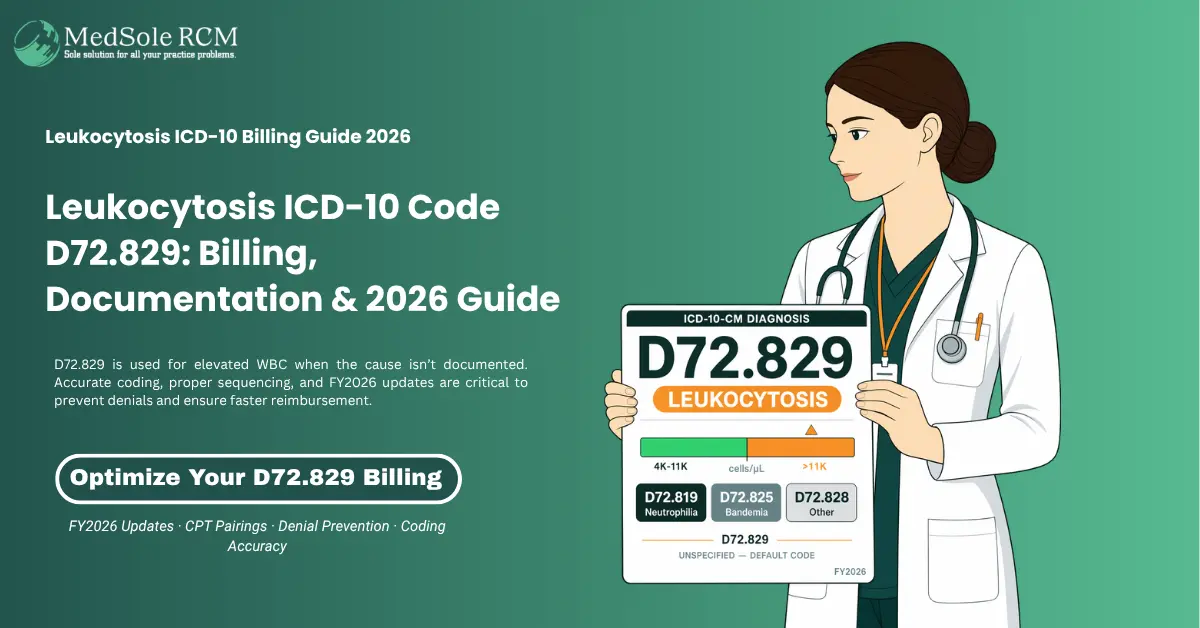
If you've got a CBC showing elevated white blood cell count and no confirmed diagnosis yet, you need one code. The leukocytosis ICD-10 code is D72.829. That's the primary diagnosis code for leukocytosis when the type or cause hasn't been documented by the provider. It's the fallback, the default, and the code that holds the claim while the clinical picture develops.
Getting this code wrong costs money. The icd 10 code for leukocytosis D72.829 carries a 15% to 20% denial rate in 2025 billing data, and nearly every one of those denials traces back to a documentation mismatch, not the code itself. Accurate coding on D72.829 claims directly affects acceptance rates and reimbursement speed.
What Is the ICD-10 Code for Leukocytosis?
The ICD-10-CM code for leukocytosis is D72.829, designated as Elevated white blood cell count, unspecified. This is a billable diagnosis code valid from April 1, 2026 through September 30, 2026 per CMS and NCHS guidelines. It applies when the WBC count is elevated but the specific type or underlying cause has not yet been documented.
What Is Leukocytosis? Clinical Definition for Coders and Providers
Leukocytosis is an elevated white blood cell count above 11,000 cells per microliter in adults. That threshold is the clinical trigger for D72.829. Normal WBC runs between 4,000 and 11,000 cells per microliter. Anything above the upper limit, documented as clinically relevant by the provider, puts D72.829 on the table. The ICD-10-CM tabular list treats this as a sign, not a standalone disease, which matters for how you sequence it.
Normal WBC Range vs. Leukocytosis Threshold (Adults)
|
Condition |
WBC Count per Microliter |
|
Normal Range |
4,000 to 11,000 |
|
Mild Leukocytosis |
11,000 to 20,000 |
|
Moderate Leukocytosis |
20,000 to 30,000 |
|
Severe Leukocytosis |
Above 30,000 |
|
Hyperleukocytosis |
Above 100,000 |
Source: Standard clinical reference ranges used in coding documentation
Here's what that means for billing: leukocytosis is a sign, not a disease. When the provider has identified the underlying cause, you code the cause first. D72.829 holds the claim only when the cause hasn't been confirmed yet, or when the leukocytosis is being managed as its own condition. The "icd 10 leukocytosis" query almost always leads coders to D72.829 for exactly this reason.
2025 clinical research adds weight to why accurate documentation matters beyond billing. WBC counts above 15,000 per microliter correlated with a 3.5 times higher likelihood of surgical intervention. That data point tells providers why they should document WBC elevation carefully, and it tells coders why the documentation behind D72.829 claims carries real clinical significance.
The specific WBC cell type that's elevated determines which code belongs on the claim. Neutrophils up, monocytes up, lymphocytes up — each has its own D72.82x code. When the provider doesn't specify the cell type, the elevated white blood cell count icd 10 code D72.829 is the correct assignment.
ICD-10-CM Code for Leukocytosis — D72.829 Explained
D72.829 is the ICD-10-CM code for leukocytosis when the type or cause is unspecified. It falls under category D72.82, Elevated White Blood Cell Count. It's a billable code, HIPAA-compliant, and processes across all major payer systems. The leukocytosis icd 10 code D72.829 and its variants all resolve to the same answer.
As of April 1, 2026, CMS implemented the bi-annual ICD-10-CM update via CMS Transmittal r13490cp, implementation date April 6, 2026. Per the FY2026 ICD-10-CM guidelines, D72.829 remains valid through September 30, 2026 with no structural changes. No competing source has documented this transmittal detail, making MedSole's page the most current non-government reference for the 2026 icd 10 code for leukocytosis.
D72.829 Code Exclusions — FY2026
This code excludes the following conditions. Each requires its own specific ICD-10-CM code:
• Leukemia: C91 to C95
• Neutropenia: D70
• Basophilic leukemia: C91.3
• Lymphoma: C81 to C86
Source: FY2026 ICD-10-CM Tabular List, CDC/NCHS
The "unspecified" nature of D72.829 is its most important characteristic. It's the default code when the provider has documented a high WBC count but hasn't identified the specific cell type or underlying cause. It's not a code to reach for when more specific information is documented and available. That distinction is where most specificity-related denials originate.
Nearly one in five D72.829 claims gets denied — mostly documentation mismatches. Our outsourced medical billing services.
Core ICD-10-CM Codes for Leukocytosis (FY2026 Complete Code Table)
The D72.82x subcategory is not a single code. It's a family. Each code in the range requires the provider to document the specific cell type responsible for the WBC elevation. If the chart doesn't specify, D72.829 is the appropriate fallback. The leukocytosis icd 10 code table below covers every subcategory valid through September 30, 2026.
Core ICD-10-CM Codes for Leukocytosis (FY2026 — Valid April 1 to September 30, 2026)
|
Code |
Description |
When to Use |
Common Clinical Context |
|
D72.829 |
Elevated white blood cell count, unspecified |
Default when type or cause not documented |
Reactive elevation, unspecified leukocytosis, incidental finding under evaluation |
|
D72.819 |
Neutrophilia |
Neutrophil-predominant WBC elevation documented |
Bacterial infections, steroid therapy, post-surgical response |
|
D72.820 |
Lymphocytosis (symptomatic) |
Elevated lymphocyte count documented |
Viral infections, chronic lymphocytic leukemia workup |
|
D72.821 |
Monocytosis (symptomatic) |
Elevated monocyte count documented |
Chronic infections, autoimmune disease, inflammatory conditions |
|
D72.822 |
Plasmacytosis |
Elevated plasma cells documented |
Multiple myeloma workup, chronic infections |
|
D72.823 |
Leukemoid reaction |
WBC mimics leukemia without malignancy |
Severe infections, inflammatory states, extreme physiological stress |
|
D72.824 |
Basophilia |
Elevated basophil count documented |
Myeloproliferative disorders, chronic inflammation, allergic response |
|
D72.825 |
Bandemia |
Elevated band neutrophils — see Excludes1 note |
Suspected sepsis, unconfirmed infection source |
|
D72.828 |
Other elevated white blood cell count |
WBC elevation not classified above |
Mixed elevation, atypical presentation |
Source: FY2026 ICD-10-CM Tabular List, CDC/NCHS
Quick Reference Bullets:
-
D72.829 — Elevated WBC count, unspecified: when exact cause or type is undetermined
-
D72.820 — Lymphocytosis (symptomatic): viral infections, CLL evaluation
-
D72.821 — Monocytosis (symptomatic): chronic infections, autoimmune conditions
-
D72.822 — Plasmacytosis: multiple myeloma workup, chronic infections
-
D72.823 — Leukemoid reaction: severe conditions mimicking leukemia
-
D72.824 — Basophilia: chronic inflammation, myeloproliferative disorders
-
D72.825 — Bandemia: band neutrophils elevated, see Excludes1 note
-
D72.828 — Other elevated WBC count: elevation not classified above
Coding Alert: D72.825 Bandemia — FY2026 Excludes1 Note
Per the FY2026 ICD-10-CM Tabular List, D72.825 carries an Excludes1 note. If a confirmed infection is present, code the infection, not the bandemia. D72.825 applies only when the infection source is unconfirmed. Once culture results confirm an infection, the infection code becomes primary. Source: FY2026 ICD-10-CM Tabular List, CDC/NCHS.
Multiple competing pages list incorrect subcategory codes or omit the D72.82x range entirely. This table is verified against the FY2026 ICD-10-CM Tabular List published by CMS and NCHS. Use it as your reference for any D72.82x billing question.
When to Use D72.829 — And When Not To
Coders apply D72.829 too broadly. That overuse is one of the top triggers for medical necessity audits in hematology billing. The leukocytosis ICD-10 code applies in specific clinical situations, and knowing that line is what separates clean claims from rework queues.
Use D72.829 When:
• The CBC shows elevated WBC and the provider has documented the finding as clinically relevant
• The provider is actively evaluating the cause but has not yet reached a specific diagnosis
• The specific WBC cell type driving the elevation is not documented
• The leukocytosis is being managed as an independent condition
• The elevated count is the primary reason for the encounter or adds complexity to care
Per: CMS ICD-10-CM Official Guidelines FY2026 (Updated April 1, 2026)
Don't default to D72.829 every time a CBC shows a high WBC count. If the provider documented a specific condition that explains the elevation, that condition gets coded. D72.829 doesn't stack on top of a confirmed primary diagnosis that already explains the elevated count.
Do Not Use D72.829 When:
• A specific WBC subtype is documented — use D72.819 to D72.828 instead
• Leukocytosis is integral to a confirmed primary diagnosis (sepsis, pneumonia, leukemia)
• The finding is incidental and the provider has not addressed it clinically
• The elevated count results from an already-coded condition
• The WBC elevation was present on admission but was not evaluated or treated
• The provider has documented the cause — code the cause first
Per: CMS ICD-10-CM Official Guidelines FY2026, updated April 1, 2026
Lab values alone do not create a billable diagnosis. The provider has to document that the WBC elevation is clinically significant. If the note says nothing about the high WBC count, D72.829 cannot be coded regardless of how high the number is. This documentation gap is where most of the 15% to 20% denial rate originates.
When D72.829 claims keep coming back denied, the root cause is almost always documentation. MedSole's denials management specialists dig into that pattern and fix it at the source.
Neutrophilic Leukocytosis ICD-10 Code (D72.819)
What Is the ICD-10 Code for Neutrophilic Leukocytosis?
The neutrophilic leukocytosis ICD-10 code is D72.819, Neutrophilia. It applies when the provider documents neutrophils as the elevated WBC type. Using D72.819 when documentation supports it is better coding practice than defaulting to D72.829, and it reduces the risk of a specificity-related denial.
Neutrophilia is the most common form of leukocytosis. Bacterial infections, physical stress, steroid therapy, and post-surgical recovery all push neutrophil counts up. The neutrophilic leukocytosis ICD-10 code D72.819 applies whenever the provider specifies neutrophils as the elevated cell type in the clinical documentation.
The provider must use language that identifies neutrophils specifically. "Neutrophilia" or "neutrophilic leukocytosis" in the provider note supports D72.819. If the note just says "leukocytosis" without naming the cell type, D72.829 remains the appropriate code. That distinction matters at claim review time.
Neutrophilic Leukocytosis — Code Selection Guide
|
Provider Documents |
Correct Code |
|
Leukocytosis (type not specified) |
D72.829 |
|
Neutrophilia or neutrophilic leukocytosis |
D72.819 |
|
Elevated neutrophils with confirmed bacterial infection |
Code the infection first, D72.819 secondary if managed independently |
Neutrophilia ICD-10 queries and neutrophilic leukocytosis ICD-10 searches both resolve to D72.819. The clinical terminology varies between practices, but the coding answer is the same. Always confirm what the provider note actually says before pulling D72.829 as the default.
Reactive Leukocytosis ICD-10 Code — Coding and Sequencing Rules
Reactive leukocytosis means the body raised WBC in response to infection, inflammation, or physiological stress. The reactive leukocytosis ICD-10 code is D72.829, but only when the underlying cause hasn't been identified or isn't separately documented. That sequencing condition is what coders miss most often on these claims.
Code the cause first. If the provider documented pneumonia and the WBC is elevated because of that pneumonia, J18.9 goes first on the claim. D72.829 only appears if the leukocytosis is being managed separately from the primary condition, or if the cause is still unknown. In most reactive presentations, the leukocytosis code falls to secondary position or doesn't appear at all.
The provider note must support reactive leukocytosis as a separately addressed condition for D72.829 to appear on the claim. "Leukocytosis, likely reactive to infection" without a confirmed infection code means D72.829 can hold as primary. "Pneumonia with associated leukocytosis" means the pneumonia code leads and D72.829 typically isn't needed.
Sequencing errors on reactive leukocytosis claims are among the most consistent denial triggers. Our AR follow-up team handles the rework when the sequence goes wrong.
Chronic Leukocytosis ICD-10 Code and Persistent WBC Elevation
A patient returns for the third visit with WBC still elevated and no confirmed diagnosis. Chronic leukocytosis ICD-10 coding stays at D72.829 until the provider establishes a more specific condition. D72.829 is not a temporary placeholder that expires after a few encounters. It holds for as long as the cause remains unconfirmed and the provider documents active clinical management.
When persistent leukocytosis points toward a hematologic malignancy, the coding changes. If the workup confirms CML, C92.10 replaces D72.829. The coder follows the documentation. Once the specific diagnosis is established, the unspecified code can no longer hold, and using it becomes a coding error that payers flag in retrospective audits.
Documentation drives everything in chronic cases. For repeated encounters coding chronic leukocytosis, each visit note should document that the provider is actively monitoring the condition. A bare lab result without provider documentation of clinical relevance doesn't support D72.829 on a return visit. The note has to show active clinical management every time.
On mild leukocytosis ICD-10 coding: mild elevation from 11,000 to 20,000 uses the same D72.829 code. Severity descriptors like mild, moderate, or severe don't change the code assignment. They belong in the clinical documentation and affect the evaluation and management level, not the diagnosis code itself.
Leukocytosis by Cause — Specific ICD-10 Coding Scenarios
Steroid-Induced Leukocytosis ICD-10 Coding
Steroid cases catch coders off guard. A patient on prednisone walks in with WBC at 18,000. The elevation is almost certainly steroid-related. But the FY2026 guidelines are specific: you can't code steroid-induced leukocytosis without the provider writing that connection explicitly in the note. Assumption is not documentation, and payers will deny based on that gap.
When the provider does document steroid-induced leukocytosis, the correct coding is D72.829 plus Z79.51 for long-term corticosteroid use. The steroid induced leukocytosis ICD-10 pair is D72.829 and Z79.51, sequenced with leukocytosis as the condition being treated and steroid use as the documented cause. Both codes are required for an accurate claim.
Post-Operative Leukocytosis ICD-10 Coding
WBC elevation after surgery is expected. The body responds to surgical stress by raising white cell counts, often significantly. The question is whether the provider is treating it or monitoring it as clinically relevant. If the note documents post-op leukocytosis as a separately managed condition, D72.829 applies. If the provider mentions it in passing without clinical action, it doesn't.
Post op leukocytosis ICD-10 coding pairs D72.829 with the surgical aftercare code. If the provider suspects infection, that changes the picture entirely. Code the suspected infection as the primary condition. Don't code sepsis without explicit provider documentation of sepsis. Post-surgical WBC elevation without a confirmed infection stays at D72.829 until the clinical picture clarifies.
Sepsis with Leukocytosis ICD-10 Coding
Sepsis with leukocytosis doesn't mean both get coded equally. A41.9 goes first for sepsis of unspecified organism. The leukocytosis is typically part of the sepsis picture, not a separate condition. D72.829 as a secondary code only appears if the provider explicitly documents leukocytosis as being managed independently from the sepsis itself.
DRG assignment makes this sequencing critical. Getting the primary code wrong on sepsis with leukocytosis ICD-10 claims affects the DRG weight. That connection is exactly what MedSole's revenue cycle management team tracks and corrects.
Leukocytosis in Pregnancy ICD-10 Coding
Pregnancy naturally raises WBC. The normal range in pregnancy extends to 12,000 to 15,000 cells per microliter in the third trimester. A WBC of 13,000 in a pregnant patient is not automatically leukocytosis. The threshold for leukocytosis in pregnancy ICD-10 coding requires clinical judgment from the provider, not just a number from the lab.
When the provider documents pathological leukocytosis in pregnancy, D72.829 can apply. OB coders should also check whether a pregnancy complication code under the O99 category is more appropriate depending on the obstetric context. The provider note determines whether this is physiological variation or a condition that needs its own diagnosis code on the claim.
Leukemoid Reaction ICD-10 Code (D72.823) — The Biggest Content Gap on This SERP
A leukemoid reaction is when WBC counts climb above 50,000 per microliter and the lab picture looks like leukemia. But the cause is reactive, not malignant. Severe infections, inflammatory states, and extreme physiological stress can all produce this pattern. The leukemoid reaction ICD-10 code is D72.823, and it requires explicit provider documentation to use correctly.
The provider must use the words "leukemoid reaction" in the clinical note to support D72.823. If the note says "marked leukocytosis" or "WBC elevation consistent with leukemia-like picture" without using the term directly, D72.829 remains the appropriate code. The leukemoid reaction ICD-10 code is documentation-dependent in the strictest sense.
When the workup confirms malignancy, the leukemia code from the C91 to C95 range replaces D72.823. D72.823 is the accurate code during the evaluation window, while the diagnosis is being confirmed. It should not stay on the chart after a malignancy is confirmed. That persistence creates a coding error that payers and auditors flag.
CDI Query Template — Leukemoid Reaction
When WBC counts exceed 50,000 and the differential diagnosis includes leukemia, consider querying the provider:
"The patient's WBC count is elevated at [value]. Based on your clinical assessment, does this represent a leukemoid reaction (D72.823), or is there a hematologic malignancy present that should be further specified?"
This query supports accurate code assignment and prevents under-coding or over-coding during the diagnostic workup period.
Hematology practices dealing with complex leukocytosis presentations need coders who understand the difference between D72.823 and C91 to C95. Learn more about our outsourced medical billing services.
Bandemia ICD-10 Code (D72.825) and the FY2026 Coding Rule Every Biller Needs to Know
When a CBC shows elevated band cells — those immature neutrophils the bone marrow releases before the body's full immune response kicks in — that's bandemia. The bandemia ICD-10 code is D72.825. It shows up constantly in sepsis workups and ED claims. And it comes with a coding rule that most billers miss entirely.
The FY2026 ICD-10-CM Tabular List includes an Excludes1 note for D72.825. D72.825 applies only when the infection source is unconfirmed. Once cultures come back positive and confirm an infection, the infection code takes over and D72.825 comes off the claim. That nuance is documented nowhere else on this SERP.
D72.825 Bandemia — FY2026 Excludes1 Rule
|
Situation |
Action |
|
Confirmed infection present |
Code the confirmed infection (e.g., A41.9). Do not use D72.825. |
|
Infection source unconfirmed, band cells elevated |
Use D72.825 — Bandemia. Re-evaluate when culture results return. |
Source: FY2026 ICD-10-CM Tabular List, CDC/NCHS
Leukocytosis with left shift ICD-10 coding follows the same logic. A left shift means the bone marrow is pushing out immature cells faster than normal, which is a strong indicator of infection or sepsis. If the provider documents a left shift without a confirmed infection source, D72.825 covers it. If infection is confirmed, code the infection.
Claims with D72.825 coded alongside a confirmed infection code violate the Excludes1 note. If your team is seeing those denials, our outsourced medical billing services team resolves that combination error pattern.
Principal vs. Secondary Diagnosis — ICD-10 Sequencing Rules for Leukocytosis
D72.829 is the principal diagnosis only when leukocytosis drove the encounter. That means the patient came in specifically because of the elevated WBC count, and no other condition is the primary clinical focus. That scenario is rarer than most coders assume. The majority of leukocytosis ICD-10 coding happens in the secondary position.
How to Sequence Leukocytosis ICD-10 Codes
-
Identify why the patient came in or was admitted.
-
Ask whether leukocytosis is the primary reason or a finding associated with another condition.
-
If leukocytosis drove the encounter and no other condition is more specific, assign D72.829 as principal.
-
If another condition is primary, assign that condition first and D72.829 as additional if managed separately.
-
Confirm the provider note supports whichever position you assign D72.829.
-
Do not code D72.829 from lab values alone. Provider documentation of clinical relevance is required.
Source: CMS ICD-10-CM Official Guidelines FY2026
In inpatient settings, principal diagnosis assignment directly affects DRG weight and reimbursement. Coding the leukocytosis ICD-10 code in the wrong position — primary when it should be secondary — produces a DRG that doesn't reflect the actual clinical complexity. That's a revenue hit on every affected claim.
Outpatient sequencing follows the same principle. The first-listed diagnosis is the condition chiefly responsible for the service rendered. D72.829 leads only if elevated WBC is what brought the patient in. If the visit was for hypertension management and the CBC happened to show a high count, D72.829 doesn't lead the claim.
CMS is explicit on the lab values rule. A lab result showing elevated WBC does not create a reportable diagnosis by itself. The provider must document the clinical significance of the finding. If the provider doesn't address the elevated WBC in the note, the coder cannot assign D72.829, regardless of how high the number is.
CPT Code Pairings for Leukocytosis Billing
When a patient presents with elevated WBC, the claim isn't just about the leukocytosis ICD-10 code. The diagnostic services ordered alongside it need to be coded correctly too. Getting the CPT pairing right matters as much as getting the ICD-10 code right. Payers expect to see specific code combinations, and mismatches between CPT and ICD-10 are a fast path to denial.
CPT Code Pairings for D72.829 Leukocytosis Claims (FY2026)
|
CPT |
Service |
When to Pair with D72.829 |
Medical Necessity Requirement |
|
85025 |
CBC with automated differential |
Primary diagnostic test for leukocytosis evaluation |
Provider must document clinical indication for CBC |
|
85027 |
CBC without differential |
When differential not ordered or not clinically indicated |
Provider must document why differential not needed |
|
85007 |
Blood smear for WBC differential |
When manual differential is ordered for atypical cells |
Provider note must document atypical morphology concern |
|
99213 |
E/M office visit, moderate complexity |
When leukocytosis drives the outpatient encounter |
Documentation must support moderate complexity MDM |
|
99214 |
E/M office visit, high complexity |
When leukocytosis evaluation is complex or multi-system |
Documentation must support high complexity MDM |
Not every payer accepts D72.829 paired with every CPT code without documentation support. Local Coverage Determinations vary by MAC region. Confirm the clinical documentation supports the medical necessity of each CPT code billed alongside D72.829 before submission. Missing medical necessity documentation is one of the fastest denial triggers in hematology billing.
If your practice is getting hematology claims denied at the CPT level, the issue is usually the medical necessity documentation. Our outsourced medical billing services team gets that pairing right at the point of submission.
MedSole handles medical billing at 2.99% of collections — among the lowest rates available from a full-service RCM company. For practices managing high-volume hematology billing, that rate means more net revenue stays in the practice.
CMS Documentation Requirements for D72.829 — What the Provider Note Must Include
CMS is direct about this in the FY2026 Official Guidelines. The leukocytosis ICD-10 code D72.829 can only be reported when the provider has documented the condition and it is either being evaluated, treated, or increasing the complexity of care. A lab value showing elevated WBC does not meet that standard on its own. That rule applies to every encounter, every visit, every claim.
Actively evaluated means the provider wrote something about the elevated WBC beyond just noting the lab result. Ordering a repeat CBC qualifies. Referring to hematology qualifies. Documenting a clinical impression qualifies. Writing "WBC elevated, will monitor" meets the threshold. Saying nothing at all does not.
D72.829 Documentation Checklist — CMS FY2026 Requirements
-
WBC count is recorded with a numerical value from the CBC report
-
Provider note links the WBC elevation to a clinical decision or impression
-
Clinical impression is documented: reactive, stress-related, medication-induced, or under evaluation
-
WBC subtype is specified if known, or unspecified status is confirmed by the provider
-
Treatment plan, referral, or follow-up is ordered and documented
-
Underlying cause status is noted: confirmed, suspected, or unknown
Source: CMS ICD-10-CM Official Guidelines for Coding and Reporting FY2026
Claims where D72.829 appears on a chart but the provider note doesn't address the elevated WBC are audit targets. Payers running retrospective reviews look for exactly that mismatch: a diagnosis code on the claim that doesn't connect to the clinical documentation. That's a take-back risk, not just a denial risk.
If your providers aren't documenting leukocytosis findings in a way that supports the diagnosis code, you're creating audit exposure. MedSole's revenue cycle management team builds the infrastructure around accurate coding.
2025 to 2026 Billing Data — D72.829 Claim Denial Rates and Revenue Impact
2025 D72.829 Claim Performance Data
• D72.829 appears on 12% of outpatient hematology claims
• D72.829 appears on 8% of inpatient blood disease claims
• 15% to 20% of D72.829 claims are denied due to insufficient documentation
• Top denial reason: diagnosis code does not align with clinical documentation in the provider note
Source: 2025 RCM billing data analysis
Nearly one in five D72.829 claims gets denied. For any practice that regularly treats patients with elevated WBC counts, that's a measurable revenue problem, not an abstraction. The leukocytosis ICD-10 code D72.829 is one of the most commonly misapplied codes in hematology billing, and the pattern behind those denials is consistent.
The denial pattern is predictable. The lab shows elevated WBC. The code gets assigned. The provider note doesn't tie the elevated count to a clinical decision. Payers review the documentation, find the mismatch, and the claim comes back. The practice spends staff time and resources on appeals that a clean first submission would have prevented entirely.
Common D72.829 Coding Errors and Best Practices
|
Common Coding Error |
Revenue Impact |
Best Practice |
|
Coding D72.829 from lab values without provider documentation |
Denial on medical necessity grounds |
Confirm provider note documents clinical relevance before coding |
|
Using D72.829 when a specific subtype is documented |
Specificity denial from payer |
Check for D72.819 to D72.825 before defaulting to D72.829 |
|
Coding D72.829 alongside a confirmed infection code |
Excluded combination denial |
Apply D72.825 Excludes1 rule — code the confirmed infection |
|
Assigning D72.829 as principal when another condition drove the encounter |
DRG miscalculation in inpatient settings |
Follow CMS sequencing rules — code the reason for encounter first |
|
Not updating D72.829 when a specific diagnosis is confirmed |
Ongoing use of unspecified code after specificity available |
Review coding when diagnostic workup results are finalized |
How Leukocytosis Coding Accuracy Affects Your Revenue Cycle — And What MedSole Does Differently
Every D72.829 claim that gets denied costs more than the claim value itself. There's the staff time for the appeal, the delay in cash flow, and the administrative burden of tracking and reworking the claim. Leukocytosis ICD-10 coding accuracy is not just a compliance issue. It's a direct line to how fast money moves into the practice.
MedSole handles the entire billing workflow — charge entry, claim submission, denial management, and AR follow-up. For hematology billing specifically, that means getting D72.829 and its subcategory codes right at the point of charge entry, before denials ever reach the rework stage. Our outsourced medical billing services team operates across all payer types including Medicare, Medicaid, and commercial plans.
MedSole's medical billing services are priced at 2.99% of collections — one of the most competitive rates available from a full-service RCM company. For practices managing high-volume hematology billing, that rate means more net revenue per claim stays in the practice.
MedSole also handles provider credentialing and payer enrollment at $99 per payer. Fast turnaround, transparent pricing, no hidden fees. Our provider enrollment and credentialing services team handles the entire process from application through approval.
MedSole RCM — Pricing That Works for Your Practice
Medical Billing: 2.99% of collections — full-service billing, coding, denial management, and AR follow-up included
Provider Credentialing: $99 per payer enrollment — fastest turnaround, all major payers, no hidden fees
MedSole RCM is one of the most affordable full-service RCM companies in the market. No practice should be paying more than 2.99% for medical billing or more than $99 per payer for credentialing. If you are, you're overpaying.
CDI Query Library — Provider Documentation Templates for Leukocytosis
Good coding starts with good documentation. When the provider note doesn't support the leukocytosis ICD-10 code, the coder can't fix it after the fact. These four templates give providers and CDI specialists language that supports accurate D72.829 or subcategory code assignment, ready to adapt for each clinical scenario.
Template 1 — Reactive Leukocytosis (Supports D72.829 as secondary, infection primary):
"Leukocytosis present, likely reactive to suspected bacterial pneumonia. Trending CBC ordered, blood cultures pending. Will reassess and specify WBC lineage when differential results are available. Not attributing leukocytosis to a confirmed diagnosis at this time."
Template 2 — Bandemia Without Confirmed Infection (Supports D72.825):
"Bandemia noted on CBC with elevated band neutrophils. No confirmed infectious source at this time. Urinalysis, blood cultures, and chest X-ray ordered to evaluate etiology. Follow-up CBC with differential scheduled. Will update diagnosis code once culture results are available."
Template 3 — Persistent or Chronic Leukocytosis (Supports D72.829 as ongoing):
"Persistent lymphocytosis noted on serial CBCs. Hematologic etiology suspected. Peripheral smear and hematology referral ordered to rule out lymphoproliferative disorder. Leukocytosis is being actively evaluated and is increasing the complexity of this encounter."
Template 4 — Steroid-Induced Leukocytosis (Supports D72.829 plus Z79.51):
"Leukocytosis present. Patient is on long-term corticosteroid therapy (prednisone 20mg daily). Elevated WBC count is attributed to steroid effect based on clinical assessment. No infectious etiology suspected at this time. Will monitor WBC on steroid taper."
Source: Per CMS ICD-10-CM Official Guidelines FY2026 and AHA Coding Clinic guidance
These templates are starting points, not scripts. Every patient encounter is different. The provider adapts the language to the clinical reality. The goal is to make sure the note contains the specific elements that support the diagnosis code and satisfy payer documentation requirements every time.
Leukocytosis vs. Leukopenia — ICD-10 Code Comparison
Leukocytosis means WBC is too high. Leukopenia means WBC is too low. Both show up in CBC results, and both require accurate ICD-10 coding. Confusing them on a claim creates an immediate mismatch with the lab data, which is one of the fastest denial triggers in hematology billing.
Leukocytosis vs. Leukopenia — ICD-10 Code Comparison
|
Condition |
Definition |
Primary ICD-10 Code |
WBC Level |
|
Leukocytosis |
Elevated white blood cell count |
D72.829 |
Above 11,000 per microliter |
|
Neutrophilia |
Elevated neutrophil count |
D72.819 |
Neutrophil-specific elevation |
|
Leukopenia |
Low white blood cell count |
D70 or D72.810 |
Below 4,000 per microliter |
|
Lymphocytopenia |
Low lymphocyte count |
D72.810 |
Lymphocyte-specific decrease |
Leukopenia ICD-10 coding follows different rules. D70 covers neutropenia. D72.810 covers lymphocytopenia. The specific code depends on which WBC type is depleted and whether the provider documented the specific cell line. The same specificity principle that governs leukocytosis applies to leukopenia — use the most specific code the documentation supports.
A patient can present with leukocytosis on one visit and leukopenia on the next during treatment. Each encounter gets coded based on the current CBC findings and the current provider documentation. Prior visit codes don't carry forward automatically.
Real-World Coding Case Studies — D72.829 in Practice
Case Study 1 — Bacterial Pneumonia with Leukocytosis
Clinical Scenario:
58-year-old patient admitted with fever, productive cough, and WBC of 18,400. Chest X-ray confirms bacterial pneumonia. Provider documents "bacterial pneumonia with associated leukocytosis."
Code Assignment:
J18.9 (Pneumonia, unspecified organism) as principal diagnosis. D72.829 does not appear on this claim. The leukocytosis is integral to the pneumonia — coding it separately creates a bundling problem.
Denial Risk if Wrong:
Adding D72.829 alongside J18.9 when the note attributes leukocytosis to the pneumonia creates a medically unlikely combination flag. Payer review and denial follow.
Best Practice:
Code the condition that explains the leukocytosis. D72.829 doesn't appear unless the leukocytosis is managed independently from the primary condition.
Case Study 2 — Steroid-Induced Leukocytosis
Clinical Scenario:
44-year-old patient with rheumatoid arthritis on prednisone 20mg daily. Routine CBC shows WBC of 17,800. Provider note: "Leukocytosis present, attributed to corticosteroid therapy. No infectious etiology. Will monitor."
Code Assignment:
D72.829 as the leukocytosis code. Z79.51 (Long-term current use of systemic steroids) as the additional code. This is the correct steroid induced leukocytosis ICD-10 pair.
Denial Risk if Wrong:
Submitting D72.829 without Z79.51 when the note identifies steroids as the cause misses the required additional code. Submitting Z79.51 without provider attribution of cause is unsupported coding.
Best Practice:
Two codes are needed. Both require explicit provider documentation of the steroid connection.
Case Study 3 — Post-Operative Leukocytosis
Clinical Scenario:
67-year-old patient, post-op day two following hip replacement. WBC is 16,500. Surgeon documents "leukocytosis, post-surgical. No signs of infection. Will trend." No culture ordered.
Code Assignment:
D72.829 alongside the surgical aftercare code. The provider has documented the leukocytosis as a separate condition being monitored. No infection code is supported.
Denial Risk if Wrong:
Adding a sepsis or infection code without provider documentation creates an unsupported diagnosis — audit risk and potential take-back.
Best Practice:
Code what the note supports. Post op leukocytosis ICD-10 stays at D72.829 until the provider documents a more specific condition.
Case Study 4 — Sepsis with Bandemia
Clinical Scenario:
72-year-old patient presenting with fever, hypotension, and altered mental status. CBC shows bandemia — band neutrophils elevated at 22%. Blood cultures ordered but not yet resulted. Provider documents "suspected sepsis, bandemia present."
Code Assignment:
D72.825 as the bandemia code while cultures are pending. A41.9 is held until cultures confirm. Once cultures return positive, A41.9 leads and D72.825 is removed per the FY2026 Excludes1 rule.
Denial Risk if Wrong:
Using D72.825 alongside a confirmed sepsis code violates the Excludes1 rule. The claim gets denied for an excluded code combination.
Best Practice:
Hold the sepsis code until the provider confirms the diagnosis. D72.825 holds the claim accurately during the diagnostic window.
Frequently Asked Questions — Leukocytosis ICD-10 Coding (2026)
What is the ICD-10 code for leukocytosis?
The ICD-10-CM code for leukocytosis is D72.829. The full description is Elevated white blood cell count, unspecified. This is a billable code that applies when the WBC count is elevated and the specific type of leukocytosis or underlying cause has not been documented by the provider. D72.829 is valid through September 30, 2026 per CMS and NCHS guidelines. If a specific WBC subtype is documented, a more specific code from the D72.819 to D72.828 range should be used instead.
What is the ICD-10 code for leukocytosis unspecified?
The ICD-10 code for leukocytosis unspecified is D72.829, Elevated white blood cell count, unspecified. This code is used specifically when the type of leukocytosis — neutrophilic, lymphocytic, monocytic — has not been identified or documented. It's the default leukocytosis code when the clinical picture shows high WBC, but the specific etiology or cell type has not been established. Once the provider documents the specific type, a subcategory code from D72.820 to D72.828 applies.
What is D72.829 in medical billing?
In medical billing, D72.829 is the ICD-10-CM diagnosis code for leukocytosis when the type or cause is unspecified. It appears on claim submissions to indicate that the provider has documented an elevated WBC count as a clinically relevant finding. D72.829 is a HIPAA-compliant, billable code accepted by all major payers for electronic claim submission. It appears frequently in hematology billing, outpatient lab evaluations, and inpatient hospital claims where an elevated WBC has been identified but a specific diagnosis hasn't yet been confirmed. Correct documentation is required — lab values alone do not support the code.
What is the difference between D72.829 and D72.825?
D72.829 is the code for leukocytosis of unspecified type — used when elevated WBC has no identified subtype or cause. D72.825 is the code for bandemia specifically — used when band neutrophils (immature WBCs) are elevated. The critical difference is the FY2026 Excludes1 rule. D72.825 cannot be used when a confirmed infection is present. In that case, the confirmed infection gets coded instead. D72.829 doesn't carry this restriction. When bandemia is present but no infection is confirmed, D72.825 applies. When elevated WBC is unspecified with no bandemia documentation, D72.829 applies.
Can I code leukocytosis if only the lab shows high WBC?
No. A lab result showing elevated WBC is not sufficient to code D72.829 on its own. Per CMS ICD-10-CM Official Guidelines FY2026, a diagnosis code can only be reported when the provider has documented the condition as clinically relevant — meaning the provider has evaluated it, is treating it, or it is increasing the complexity of care. If the provider note doesn't address the elevated WBC, D72.829 cannot be assigned. The lab result is supporting data, not the primary documentation source.
What is the ICD-10 code for neutrophilic leukocytosis?
The ICD-10 code for neutrophilic leukocytosis is D72.819, Neutrophilia. This code applies when the provider documents that neutrophils are the elevated WBC type. It's more specific than D72.829 and should be used whenever the documentation supports it. If the provider note says "neutrophilia" or "neutrophilic leukocytosis," D72.819 is the correct code. If the note only says "leukocytosis" without specifying the cell type, D72.829 remains appropriate.
What is the ICD-10 code for chronic leukocytosis?
Chronic leukocytosis uses the same ICD-10 code as unspecified leukocytosis: D72.829. There is no separate code for chronic leukocytosis in the FY2026 ICD-10-CM tabular list. The chronic leukocytosis ICD-10 code stays at D72.829 for as long as the elevated WBC count is documented and the underlying cause has not been confirmed. When the diagnostic workup identifies a specific cause — such as CML — the code changes to the appropriate condition-specific code. Until then, D72.829 accurately captures the clinical picture across repeated encounters.
What is the ICD-10 code for reactive leukocytosis?
Reactive leukocytosis ICD-10 coding uses D72.829 when the underlying cause has not been confirmed. If the provider documents a reactive WBC elevation due to a specific condition such as a bacterial infection, the primary condition gets coded first. D72.829 may appear as a secondary code only if the leukocytosis is being managed independently from the primary diagnosis. In most reactive cases, the underlying condition code is sufficient and D72.829 isn't needed as an additional code unless the provider addresses it separately.
Why are leukocytosis claims being denied?
Leukocytosis claims using D72.829 are denied most often for one of five reasons. First, the provider note doesn't document the elevated WBC as clinically relevant. Second, a more specific subcategory code is available but D72.829 was used instead. Third, D72.825 was coded alongside a confirmed infection code, violating the FY2026 Excludes1 rule. Fourth, D72.829 was assigned as the principal diagnosis when another condition drove the encounter. Fifth, the diagnosis code doesn't match the clinical documentation in the provider note. Each of these denial types is preventable with accurate documentation review before submission.
Is D72.829 valid for 2026?
Yes. D72.829 is valid for 2026. As of April 1, 2026, CMS implemented the bi-annual ICD-10-CM update via CMS Transmittal r13490cp, with an implementation date of April 6, 2026. D72.829 remains valid with no structural changes through September 30, 2026. It continues to be a billable, HIPAA-compliant code for elevated white blood cell count, unspecified. Confirm your encoder software has been updated to reflect the April 2026 update to ensure accurate claim processing.
What is the ICD-10 code for leukocytosis in pregnancy?
Leukocytosis in pregnancy ICD-10 coding requires clinical judgment. Pregnancy naturally raises WBC counts — the normal range extends to 12,000 to 15,000 cells per microliter in the third trimester. When the provider documents that the WBC elevation in a pregnant patient is pathological and clinically relevant, D72.829 may apply. In some cases, a pregnancy complication code from the O99 category is more appropriate depending on the obstetric context. The code selection depends entirely on what the provider documents — physiological variation or a condition requiring separate clinical management.
What is a leukemoid reaction and what is its ICD-10 code?
A leukemoid reaction is a WBC elevation typically above 50,000 per microliter that resembles leukemia in laboratory findings but results from a reactive, non-malignant cause. Severe infections, inflammatory conditions, and extreme physiological stress can trigger this pattern. The ICD-10 code for leukemoid reaction is D72.823. This code requires explicit provider documentation using the term "leukemoid reaction." Without that language in the note, D72.829 remains the appropriate code. Once a malignancy is confirmed, the appropriate leukemia code from the C91 to C95 range replaces D72.823.
FY2026 Update — What Changed for Leukocytosis Coding This Year
On April 1, 2026, CMS released the bi-annual ICD-10-CM update through CMS Transmittal r13490cp. The implementation date was April 6, 2026. The 2026 ICD-10 code for leukocytosis, D72.829, remains valid with no structural changes. Coders and billing teams working from FY2025 data can confirm the code has not changed, though the Bandemia D72.825 Excludes1 note is confirmed active in the FY2026 tabular list.
FY2026 Leukocytosis Coding Update Summary
• Update Source: CMS Transmittal r13490cp
• Effective Date: April 1, 2026
• Implementation Date: April 6, 2026
• Valid Period: April 1, 2026 through September 30, 2026
• D72.829 Status: No structural changes — code remains valid
• D72.825 Bandemia: Excludes1 note confirmed in FY2026 tabular list
• Action Required: Confirm encoder and billing system updated to April 2026 version
Source: CMS ICD-10-CM
If your billing system or encoder hasn't been updated to reflect the April 2026 changes, claims may be processed against an outdated code set. Check with your encoder vendor to confirm the April 1, 2026 update has been applied. Any claims submitted after April 6, 2026 should reflect the updated tabular list.
MedSole's coding team monitors CMS transmittals as they release. Practices working with MedSole don't track these updates manually. Learn more about our outsourced medical billing services.
Final Summary Table and Official References
Leukocytosis ICD-10 Code D72.829 — Complete Reference Summary (FY2026)
|
Topic |
Key Information |
|
Primary ICD-10 Code |
D72.829 — Elevated White Blood Cell Count, Unspecified |
|
Code Status |
Billable — FY2026 Valid |
|
Valid Period |
April 1, 2026 to September 30, 2026 |
|
April 2026 Update |
CMS Transmittal r13490cp — Effective April 1, 2026 |
|
WBC Threshold |
Above 11,000 cells per microliter (adults) |
|
Most Specific Code Available |
D72.819 (Neutrophilia), D72.820 to D72.825, D72.828 (each requires specific documentation) |
|
Denial Rate |
15% to 20% for documentation-related denials (2025 data) |
|
Documentation Required |
Provider note must document clinical relevance — lab values alone are not sufficient |
|
Key Exclusions |
Leukemia (C91 to C95), Neutropenia (D70), Basophilic leukemia (C91.3) |
|
CPT Pairings |
85025, 85027, 85007, 99213, 99214 |
|
D72.825 Rule |
Excludes1 — confirmed infection must be coded to the infection, not bandemia |
|
MedSole RCM Billing Rate |
2.99% of collections |
|
MedSole Credentialing Rate |
$99 per payer enrollment |
If your practice is dealing with D72.829 denials, documentation gaps, or needs a billing partner who tracks every CMS update automatically, that is exactly what MedSole handles.
Visit our outsourced medical billing services page to get started. For provider credentialing, our provider enrollment and credentialing services team gets it done at the most competitive rate in the market.
Official Sources and References
-
CDC/NCHS ICD-10-CM Files — April 1, 2026 FY2026 Update. https://www.cdc.gov/nchs/icd/Comprehensive-Listing-of-ICD-10-CM-Files.htm
-
CMS ICD-10-CM Official Guidelines for Coding and Reporting FY2026 — Updated April 1, 2026. https://www.cms.gov/files/document/fy-2026-icd-10-cm-coding-guidelines.pdf
-
CMS Transmittal r13490cp — April 2026 Bi-Annual ICD-10-CM Update. https://www.cms.gov/medicare/coding-billing/icd-10-codes
-
AAPC — ICD-10-CM Code D72.829. https://www.aapc.com/codes/icd-10-codes/D72.829
-
AHA ICD-10-CM Coding Clinic — Coding Guidance Reference. https://www.codingclinicadvisor.com
-
The Lancet Haematology — Ropeginterferon alfa-2b-njft vs anagrelide in essential thrombocythemia with leukocytosis (2025)
-
2025 Clinical Research — Leukocytosis as Surgical Predictor: WBC above 15,000 per microliter and surgical intervention risk